


Selective detection of tyrosine kinase inhibitor erdafitinib using nitrogen-doped carbon dots synthesized at room temperature

Research Abstract

Erdafitinib (ERDF), despite its known adverse effects, remains a key chemotherapeutic agent for metastatic urothelial carcinoma, requiring reliable monitoring in biological matrices to ensure safe and effective treatment. In this study, we developed a cost-effective, energy-efficient method for synthesizing highly fluorescent nitrogen-doped carbon dots (NCDs) using simple precursors. The resulting NCDs displayed excellent photostability and a high fluorescence quantum yield of 41.87%. ERDF induced a concentration-dependent quenching of the NCDs' fluorescence at 520 nm, attributed to the inner filter effect, with a low detection limit of 0.013 μM (S/N = 3). The NCDs demonstrated high selectivity toward ERDF with minimal interference from coexisting substances. Recovery rates in spiked human serum and urine ranged from 97.8% to 104.4%, validating the method's practical applicability. The relative standard deviations (RSDs) remained below 3.72%, confirming the precision and reproducibility of the NCD-based sensing platform.

Research Authors
Mohamed N. Goda, Laila S. Alqarni, Yasmeen G. Abou Elreash, Hossieny Ibrahim, Al-Montaser Bellah H. Ali, Mohamed M. El-Wekil
Research Date
Research Journal
Analytical Methods
Research Pages
5929-5938
Research Publisher
RSC
Research Rank
Q2
Research Vol
17
Research Website
https://doi.org/10.1039/D5AY00833F
Research Year
2025

Nickel ferrite–halloysite nanocomposite-modified GCE for nanomolar detection of purine bases: Toward early disease diagnosis

Research Abstract

Purine bases such as adenine and guanine are fundamental components of nucleic acids and are involved in critical metabolic processes. Abnormal elevations in their concentrations have been associated with various pathological conditions, including cancer. In this study, a highly sensitive voltammetric sensor was developed by modifying a glassy carbon electrode (GCE) with nickel ferrite nanoparticles (NiFe₂O₄ NPs) anchored onto halloysite nanotubes (HNTs), forming a NiFe₂O₄ NPs@HNTs composite. The synergistic integration of redox-active NiFe₂O₄ NPs and high-surface-area, biocompatible HNTs significantly enhanced the electrochemical response by increasing the active surface area, improving electron transfer kinetics, and facilitating strong analyte adsorption. This composite enabled well-defined, irreversible oxidation peaks for both adenine and guanine, with a wide linear detection range from 0.05 to 200 μM. The calculated limits of detection (LODs) were 2.2 nM for adenine and 1.4 nM for guanine, indicating excellent sensitivity. When tested in pre-treated human saliva and serum samples, the sensor achieved recovery rates ranging from 95.7% to 105.2%, with relative standard deviations below 4.21%, confirming its accuracy and reliability in complex biological matrices. These findings highlight the sensor’s strong potential for future clinical applications in purine base monitoring and biomarker-based disease diagnostics.

Research Authors
Mohamed N. Goda, Laila S. Alqarni, Yasmeen G. Abou Elreash, Hossieny Ibrahim, Al-Montaser Bellah H. Ali, Mohamed M. El-Wekil
Research Date
Research Journal
Microchemical Journal
Research Pages
115661
Research Publisher
ElSevier
Research Rank
Q1
Research Vol
218
Research Website
https://doi.org/10.1016/j.microc.2025.115661
Research Year
2025

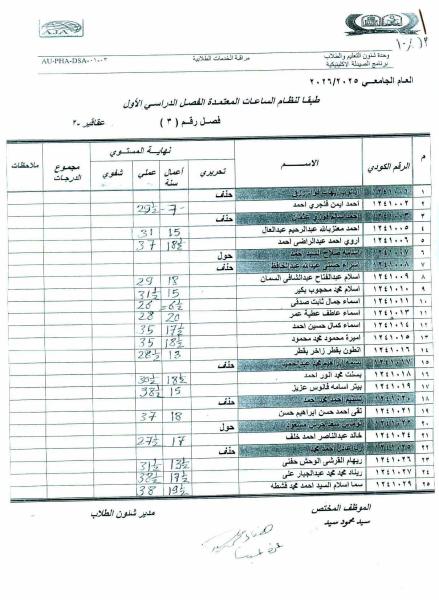
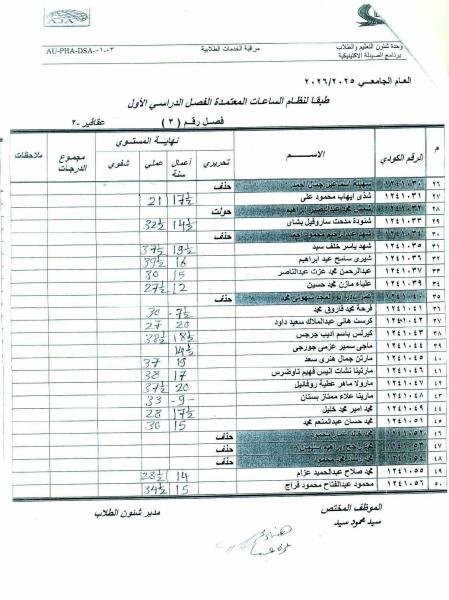
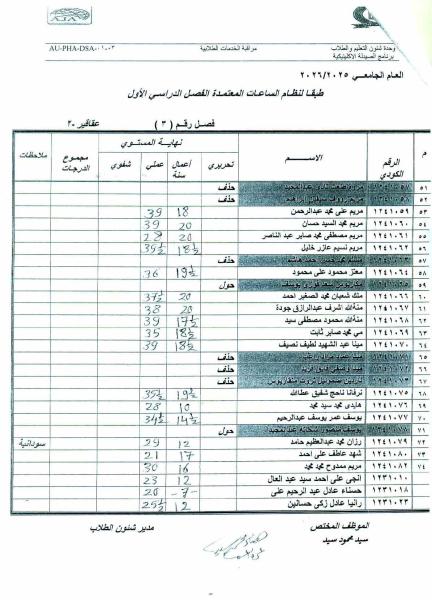
Results of the practical grades for the " Applied and Forensic Pharmacognosy" course – for fourth-year PharmD students, first semester, academic year 2025/2026

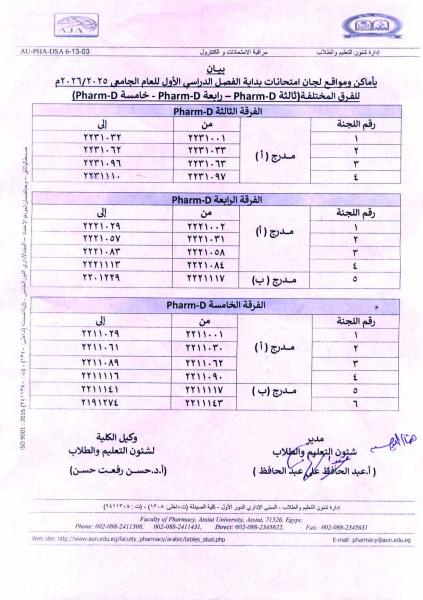
Practical Exam Grades for the Course “Pharmacognosy 2” For students of Assiut National University – Faculty of Pharmacy and Pharmaceutical Research First Semester of the Academic Year 2025/2026.

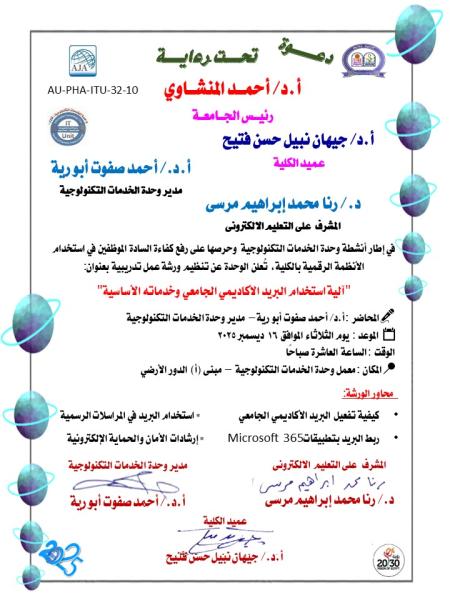
The Technology Services Unit announces the organization of a training workshop entitled “Mechanism of Using the University Academic Email and Its Basic Services,” to be held on Tuesday, December 16, 2025.

As part of the activities of the Technological Services Unit and its commitment to enhancing the efficiency of staff members in using digital systems at the Faculty, the Unit announces the organization of a training workshop entitled:

“Mechanism of Using the University Academic Email and Its Basic Services”

🎤 Lecturer: Prof. Dr. Ahmed Safwat Abu Raya – Director of the Technological Services Unit
📆 Date: Tuesday, 16 December 2025
⏰ Time: 10:00 a.m.
📍 Venue: Technological Services Unit Lab – Building (A), Ground Floor

Workshop Topics:

  • How to activate the university academic email

  • Using the academic email for official correspondence

  • Linking the email with Microsoft 365 applications

  • Electronic security and protection guidelines


news category
خبر عام
Subscribe to