




 Do you have any questions? (088) 2080369 - 2345622 Pharmacy_QAAU@pharm.aun.edu.eg
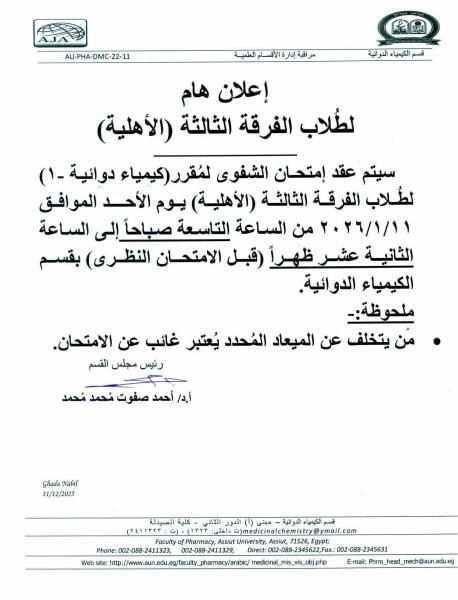
Important announcement for third-year students at the National University: The oral exam for Medicinal Chemistry Iwill be held on Sunday, 11 January 2026
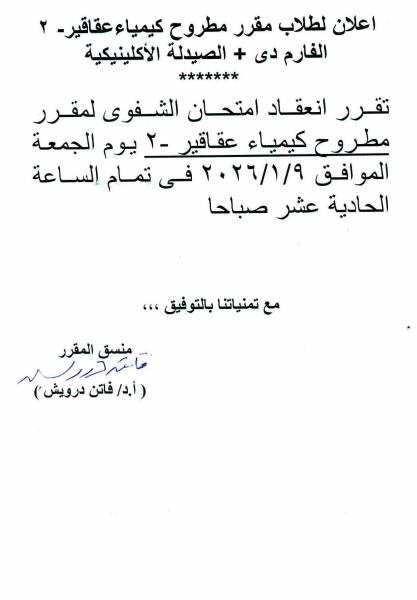
Announcement for students of the Phytochemistry IIcourse (Pharm-D and Clinical Pharmacy — Matrouh branch): The oral exam will be held on Friday, 9 January 2026

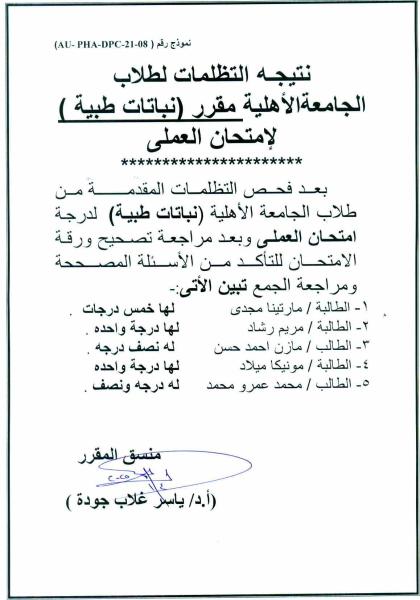
Appeal results for the Practical Exam of the Medical Plants course for National University students

news category
إعلانات الطلاب
Congratulations

Meeting of the Department of Pharmacognosy Council at the Faculty of Pharmacy This will take place on Sunday, January 4, 2026
God willing, the 66th meeting of the Department of Pharmacognosy Council at the Faculty of Pharmacy This will take place on Sunday, January 4, 2026, at 11:00 AM.
in the department council meeting room.
news category
خبر عام
Meeting of the Council of the Pharmaceutics Department, Faculty of This will take place on Monday, January 5, 2026.
God willing, the meeting of the Pharmaceutics Department Board of the Faculty of Pharmacy No. (546) This will take place on Monday, January 5, 2026 at 11:00 AM.
in the department board on the third floor under the chairmanship of the Faculty to discuss the topics that we will inform you later.
news category
خبر عام
Meeting of the Council of the Pharmaceutical Analytical Chemistry Department, Faculty of Pharmacy This will take place on Sunday, January 4, 2026.
God willing, The Pharmaceutical Analytical Chemistry Department Council will hold its regular monthly meeting No. (534) This will take place on Sunday, January 4, 2026, at 11:00 AM.
In the meetings Hall of the Department
news category
خبر عام
Design, Synthesis, and Antiproliferative Activity of Novel Indole/1,2,4-Triazole Hybrids as Tubulin Polymerization Inhibitors
Research Abstract
New indole/1,2,4-triazole hybrids were synthesized
and tested for antiproliferative activity against the NCI 60 cell line as tubulin polymerization
inhibitors. Methods: All final compounds, 6a–j and 7a–j were evaluated at a single
concentration of 10 μM against a panel of sixty cancer cell lines. Results: Compounds 7a–j,
featuring the NO-releasing oxime moiety, exhibited superior anticancer activity to their
precursor ketones 6a–j across all tested cancer cell lines. Compounds 6h, 7h, 7i, and 7j
were chosen for five-dose evaluations against a comprehensive array of 60 human tumor
cell lines. The data showed that all tested compounds had significant anticancer activity
throughout the nine tumor subpanels studied, with selectivity ratios ranging from 0.52 to
2.29 at the GI50 level. Compounds 7h and 7j showed substantial anticancer effectiveness
against most cell lines across nine subpanels, with GI50 values ranging from 1.85 to 5.76 μM
and 2.45 to 5.23 μM. Compounds 6h, 7h, 7i, and 7j were assessed for their inhibitory
effects on tubulin polymerization. Conclusions: The results showed that compound 7i, an
oxime-based derivative, was the most effective at blocking tubulin, with an IC50 value of
3.03 ± 0.11 μM. This was compared to the standard drug CA-4, which had an IC50 value of
8.33 ± 0.29 μM. Additionally, cell cycle analysis and apoptosis assays were performed for
compound 7i. Molecular computational investigations have been performed to examine
the binding mode of the most effective compounds to the target enzyme.
Research Date
Research Department
Research Journal
Pharmaceuticals
Research Member
Research Pages
275
Research Publisher
MDPI
Research Rank
Pharmaceutical Chemistry, Q1
Research Vol
18
Research Year
2025
Design, synthesis, and antiproliferative activity of new 5-ethylsulfonylindazole- 3-carbohydrazides as dual EGFR/VEGFR-2 kinases inhibitors
Research Abstract
A novel series of 5-ethylsulfonyl-indazole-3-carbohydrazides 7a–o, serving as dual inhibitors of EGFR
and VEGFR-2 was developed. The antiproliferative effects of compounds 7a–o were assessed against
four cancer cell lines via the MTT assay. Compounds 7g, 7i–7l, and 7o emerged as the most efficient
six derivatives, with GI50 values ranging from 25 nM to 42 nM. Compounds 7j, 7k, and 7o (GI50 values
of 27, 25, and 30, respectively) demonstrated greater potency than erlotinib (GI50 value of 33 nM),
particularly against breast (MCF-7) cancer cell lines, and were identified as the most potent dual
EGFR/VEGFR-2 inhibitors. Apoptotic markers assay results showed that increased levels of p53 and
Bax proteins, along with lower levels of antiapoptotic Bcl-2, govern the apoptosis process in these
new compounds. Computational analyses, encompassing molecular docking, molecular dynamics
(MD) simulations, and density functional theory (DFT) computations, elucidated the binding
interactions of these drugs with EGFR and VEGFR-2.
Research Date
Research Department
Research Journal
Journal of Enzyme inhibition and Medicinal Chemistry
Research Member
Research Pages
2516075
Research Publisher
Taylor and Francis
Research Rank
Pharmaceutical Chemistry, Q1
Research Vol
40(1)
Research Year
2025