



 Do you have any questions? (088) 2080369 - 2345622 Pharmacy_QAAU@pharm.aun.edu.eg
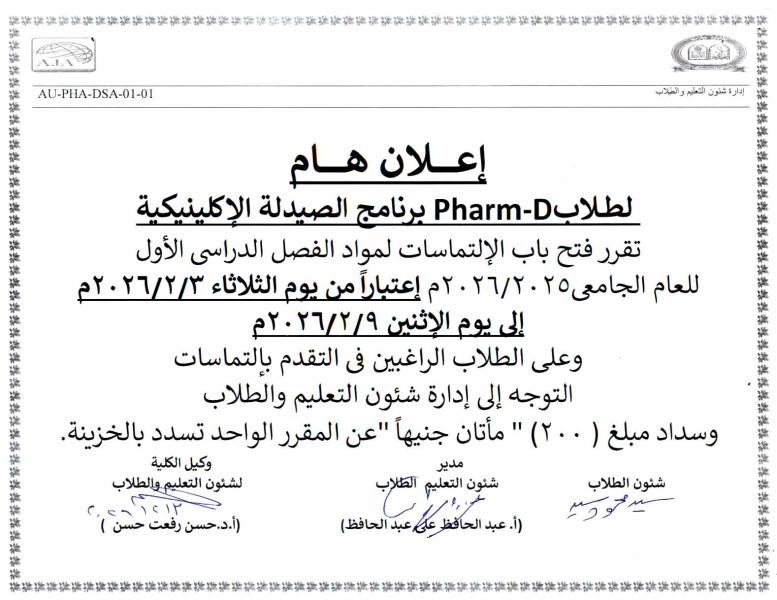
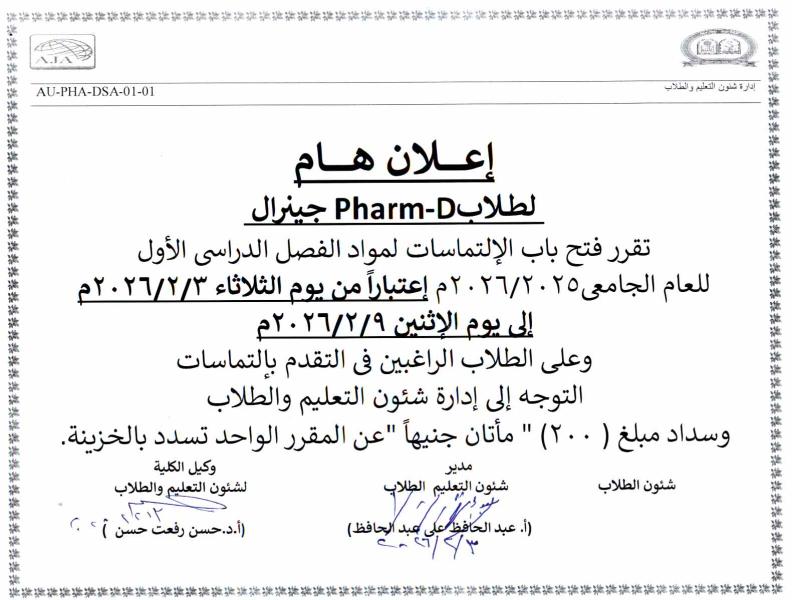
Important and urgent for Pharm-D (Clinical Pharmacy) students: The appeals process for first semester courses for the 2025/2026 academic year is now open.
Important and urgent for Pharm-D students: The appeals process for first semester courses for the 2025/2026 academic year is now open.
Results of the first semester, fourth year, Pharmacy Department, academic year 2025/2026
news category
إعلانات الطلاب
Results for the first semester of the second year, Pharmacy program, academic year 2025/2026
news category
إعلانات الطلاب
The faculty extends its congratulations to Professor Dr. Tarek Aboul-Fadl Mohamed Hassan, Professor in the Department of Medicinal Chemistry, on his research project receiving funding from the faculty for the academic year 2025/2026.

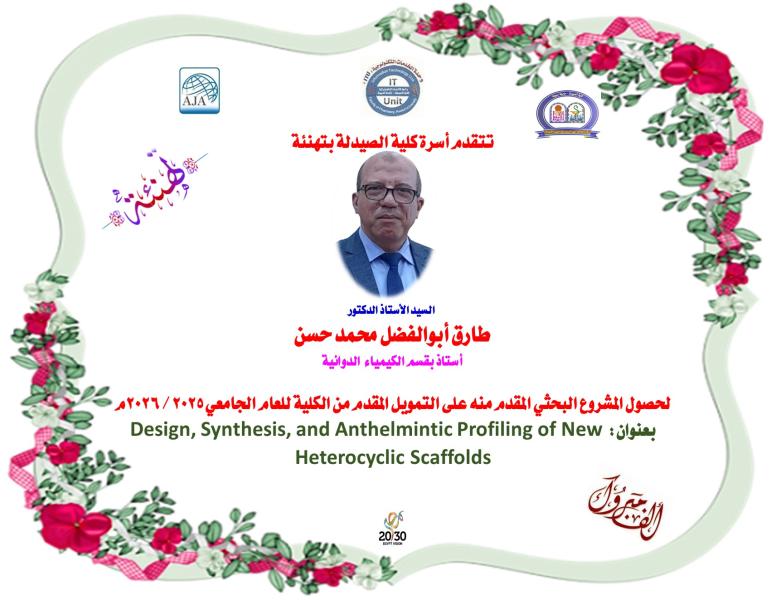
The Faculty extends its congratulations to
Professor Dr. Tarek Aboul-Fadl Mohamed Hassan,
Professor in the Department of Medicinal Chemistry, on receiving funding for his research project entitled: "Design, Synthesis, and Anthelmintic Profiling of New Heterocyclic Scaffolds" for the academic year 2025/2026.
news category
خبر عام
Results of the first semester, fifth year, Pharmacy Department, academic year 2025/2026
news category
إعلانات الطلاب
Nature-inspired chalcone-functionalized paracetamol derivatives as potential anticancer leads: synthesis, biological evaluation, apoptotic mechanisms, and in silico docking studies
Research Abstract
Inspired by the known anticancer activities of hydroxychalcones and acetamidochalcones, a series of novel hybrid molecules integrating these motifs with a paracetamol core were designed and synthesized. The synthesized chalcone–paracetamol hybrids were evaluated for their antiproliferative activity against a panel of eight human cancer cell lines. Compounds 6a, 6b, and 9, showed good activity against four cancer cell lines (U937, Jurkat, HCT-116 and MCF-7 cells). Notably, derivative 9 was the most potent with IC50 ranging from 1.50 to 4.50 μM, while showing no significant toxicity toward normal cells. Mechanistic investigations revealed that compound 9 induced cell cycle arrest at G0/G1 phase and stimulated apoptosis. Further biochemical analysis identified it (9) as a multi-target agent, with significant inhibitory activity against EGFR (0.62 ± 0.02 μM), VEGFR-2 (2.26 ± 0.01 μM), COX-2 (17.38 ± 0.13 μM), and tubulin polymerization (19.31 ± 0.29 μM). Molecular docking analysis supported these results, showing strong binding affinities for the respective target proteins, with high binding scores of compound 9 ranging from (−9.2 to −10.0) kcal/mol. Collectively, these findings highlight that compound 9 is worthy of further investigation as a potential anticancer lead.
Research Date
Research Department
Research Journal
Bioorganic & Medicinal Chemistry Letters
Research Member
Research Pages
130562
Research Publisher
Elsevier
Research Vol
134
Research Website
https://www.sciencedirect.com/science/article/pii/S0960894X26000296?dgcid=author
Research Year
2026
CDK2 Inhibitors: Rationally Directed Discovery of a Novel Potent Lead derived from Cyclohepta[e]thieno[2,3-b]pyridine
Research Abstract
CDK2 has emerged as a pivotal target in cancer chemotherapy. To develop a novel CDK2 inhibitor scaffold, multiple rational, structure-based design strategies were applied to known potent CDK2 inhibitors. Through retrosynthetic planning, chemical synthesis, and characterisation, compounds 2–8 were generated. Initial in vitro screening using the NCI-60 cancer cell line panel, followed by accurate cytotoxicity (GI50) measurements, shortlisted compounds 5, 8b, and 8d as promising candidates. These compounds exhibited GI50 values as low as 0.6 μM and demonstrated favourable safety profiles, with selectivity indices reaching up to 7.98. The top two active compounds, 5 and 8b, were further evaluated against the most sensitive cell line, MDA-MB-468 (breast cancer), at their respective GI50 concentrations. Flow cytometric cell cycle analysis revealed 82% and 78% G1 phase arrest for compounds 5 and 8b, respectively, suggesting an effective CDK2/cyclin E targeting mechanism. Furthermore, annexin V-FITC apoptosis assays showed robust pro-apoptotic effects, with total apoptosis induction elevated 34.5-fold and 32.4-fold over the negative control for compounds 5 and 8b, respectively. Subsequent CDK2/cyclin E1 enzymatic inhibition assays confirmed the potency of these compounds, with IC50 values of 3.92 nM for 5 and 0.77 nM for 8b, compared to 1.94 nM for the reference inhibitor roscovitine. Notably, the novel lead compound 8b exhibited approximately 2.5-fold greater potency than roscovitine. Molecular docking studies further supported the experimental findings and provided structural insights for future optimisation of this promising CDK2 inhibitor scaffold.
Research Date
Research Department
Research Journal
RSC Medicinal Chemistry
Research Member
Research Pages
4960-4972
Research Publisher
RSC
Research Vol
16
Research Website
https://pubs.rsc.org/en/content/articlelanding/2025/md/d5md00346f
Research Year
2025
Synthesis, characterization and antimicrobial activity of new 1,2,4-triazole and pyridine derivatives bearing methyl 4-aminosalicylate moiety as a substructure
Research Abstract
A general procedure was developed to synthesize and characterize some new 1,2,4-triazole, 3-cyanopyridine, 3-aminothienoquinoline and 5,6,7,8-tetrahydroisoquinoline derivatives bearing a 4-aminosalicylic acid ester moiety as substructure. Some of them were further modified to give new derivatives. This work allowed the preparation of 18 new compounds obtained in good yields and under simple experimental conditions. These compounds were evaluated for their antimicrobial activity against four strains of bacteria and two fungal species.
Research Date
Research Department
Research Journal
Arkivoc
Research Member
Research Pages
202512361
Research Publisher
ARKAT USA, Inc.
Research Vol
5
Research Website
https://www.arkat-usa.org/browse-arkivoc/browse-arkivoc/ark.5550190.p012.361
Research Year
2025