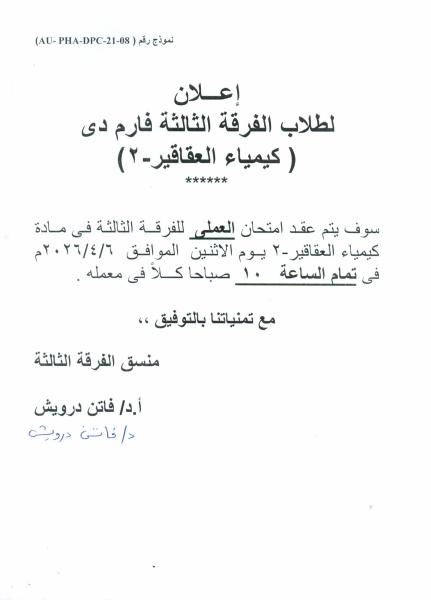
Important Announcement To Third-Year Students (PharmD) Practical Exam Schedule for " Phytochemistry -2"

The Practical Exam for the third-year course Phytochemistry -2will be held on Monday, April 6, 2026, at 10:00 AM.

The exam will take place for each student in their respective designated laboratory.

With our best wishes for success!

news category
إعلانات الطلاب

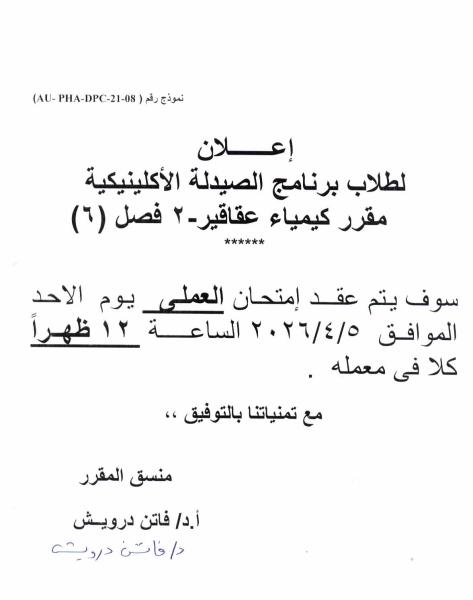
Announcement Clinical Pharmacy Program - Level 3 (Semester 6) Practical Exam Schedule for " Phytochemistry -2"

The Practical Exam for the Phytochemistry -2course will be held on Sunday, April 5, 2026, at 12:00 PM.

The exam will take place for each student in their respective designated laboratory.

Best of luck to all students!

news category
إعلانات الطلاب

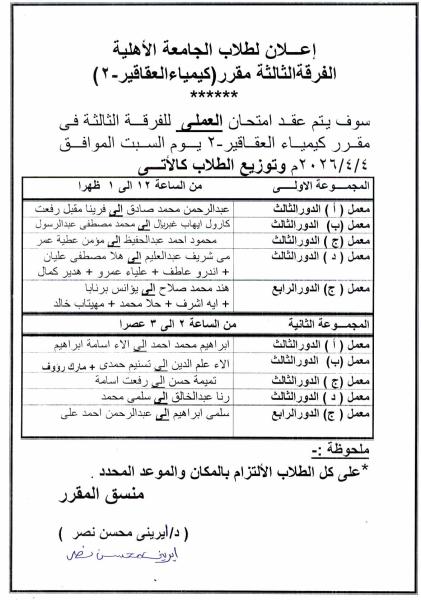
Announcement To Third-Year National University Students Practical Exam Schedule for " Phytochemistry -2" Saturday, April 4, 2026

The Practical Exam for the third-year course Phytochemistry -2 will be held on Saturday, April 4, 2026. Students are distributed as follows:

Group 1: From 12:00 PM to 1:00 PM

LabLocationStudent Range
Lab (A)3rd FloorAbdelrahman Mohamed Sadek to Verina Mokbel Refaat
Lab (B)3rd FloorCarole Ihab Ghobrial to Mohamed Mostafa Abdelrasoul
Lab (C)3rd FloorMahmoud Ahmed Abdelhafiz to Moamen Atteya Omar
Lab (D)3rd FloorMai Sherif Abdelalim to Hala Mostafa Alian (+ Andrew Atef, Alyaa Amr, Hadeer Kamal)
Lab (C)4th FloorHind Mohamed Salah to Yoanis Barnaba (+ Aya Ashraf, Hala Mohamed, Mohitab Khaled)

Group 2: From 2:00 PM to 3:00 PM

LabLocationStudent Range
Lab (A)3rd FloorIbrahim Mohamed Ahmed to Alaa Osama Ibrahim
Lab (B)3rd FloorAlaa Alam El-Din to Tasneem Hamdy (+ Mark Raouf)
Lab (C)3rd FloorTamima Hassan to Refaat Osama
Lab (D)3rd FloorRana Abdelkhalek to Salma Mohamed
Lab (C)4th FloorSalma Ibrahim to Abdelrahman Ahmed Ali

Note:

  • All students must strictly adhere to the specified time and location.

news category
إعلانات الطلاب

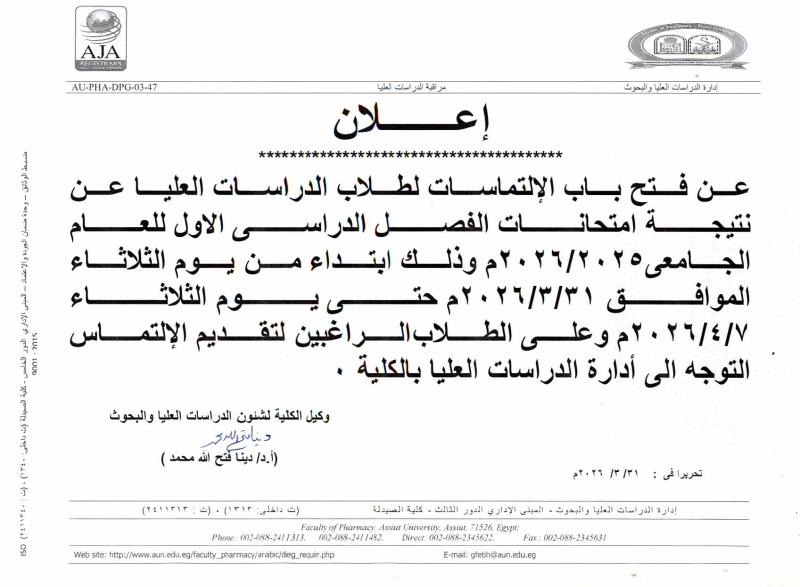
Important Announcement Postgraduate Students: Appeals and Grievances (Semester 1 Results) Academic Year 2025/2026

This is to announce the opening of the Appeals (Grievances) period for postgraduate students regarding the First Semester examination results.

  • Start Date: Tuesday, March 31, 2026.

  • End Date: Tuesday, April 7, 2026.

Students wishing to submit an appeal must visit the Postgraduate Affairs Office at the faculty to complete the necessary procedures.


news category
إعلانات الدراسات العليا

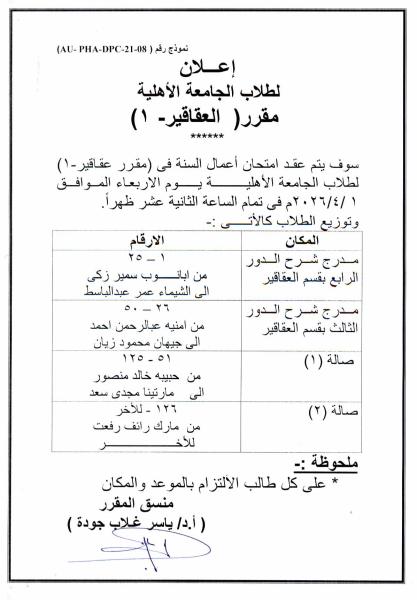
Announcement of the Midterm Exam for the Course (Pharmacognosy I) for Al Ahliyya University Students, to be held on Wednesday, April 1, 2026

The midterm exam for the course (Pharmacognosy I) will be held for Al Ahliyya University students on Wednesday, April 1, 2026, at 12:00 PM.

  • Student distribution is as follows:

Numbers

Location

1–25 From Ebanoub Samir Zaki To Elshaimaa Omar Abdelbaset

Lecture Hall, 4th Floor – Pharmacognosy Department

26–50 From Omnia Abdelrahman Ahmed To Gehan Mahmoud Zidan

Lecture Hall, 3rd Floor – Pharmacognosy Department

51–125 From Habiba Khaled Mansour To Martina Magdy Saad

Hall (1)

126–End From Mark Raef Refaat To End

Hall (2)


  • Note:
    All students must adhere to the assigned time and location.


news category
إعلانات الطلاب

Design, synthesis, and characterization of novel 5- ethylsulfonyl-indazole-3-carboxamides as dual VEGFR-2 and EGFR inhibitors: apoptotic antiproliferative and immunomodulatory evaluations

Research Abstract

This study focused on the design and synthesis of a novel series of 5-ethylsulfonyl-indazole-3-carboxamides (8a–l) as dual inhibitors of VEGFR-2 and EGFR. Compounds 8g and 8h emerged as the most efficient derivatives among all evaluated compounds against breast (MCF-7) and colorectal (HCT-116) cancer cell lines, exhibiting IC50 values of 24 and 28 nM for HCT-116 and MCF-7 cell lines, respectively, for 8g and 23 and 25 nM for the same cell lines for 8h. Compounds 8g and 8h exhibited a promising safety margin against normal cells (WI-38) (IC50 values > 150 nM). In vitro enzyme assays demonstrated that compounds 8g and 8h exhibited potent inhibition of VEGFR-2 and EGFR. Furthermore, compounds 8g and 8h induced apoptosis by activating Bax, p53, caspase-3, 8, and 9, as well as down-regulating Bcl-2. Compounds 8g and 8h reduced TNF-a and IL-6 levels compared to dexamethasone. The computational investigation of compound 8h, a novel indazole-based urea derivative, was undertaken to rationalize its potent dual inhibition of EGFR and VEGFR-2. Molecular docking studies revealed a high binding affinity and a favorable interaction profile with key kinases.
residues, particularly hinge-region contacts with Met769 (EGFR) and Glu885/Asp1046 (VEGFR-2). Follow-up molecular dynamics (MD) simulations confirmed the stability of the 8h–EGFR complex over 150 ns, characterized by persistent hydrogen bonding, low RMSF in the binding site, and consistent radius of gyration. Quantum mechanical (QM) analyses, including DFT and MEP mapping, revealed a HOMO–LUMO gap of 4.55 eV, high dipole moment (9.3 D), and distinct electron-rich/hydrogen-bonding regions, supporting strong molecular interactions. Additionally, SwissADME profiling
demonstrated acceptable drug-likeness, moderate solubility, and a low CYP-inhibition profile, suggesting favorable pharmacokinetics compared to the reference inhibitor erlotinib. These integrated computational findings align with experimental data on antiproliferative effects and kinase inhibition, reinforcing compound 8h as a promising dual-target anticancer candidate.

Research Authors
Lamya H. Al-Wahaibi, Shimaa A. Othman, Hesham A. Abou-Zied, Stefan Br¨ase, Bahaa G. M. Youssif and Safwat M. Rabea

Research Date
Research Journal
RSC Advances
Research Pages
47710
Research Publisher
Royal Society of Chemistry
Research Rank
Pharmaceutical Chemistry, Q2
Research Vol
15
Research Year
2025

Design, synthesis, antiproliferative activity, and molecular dynamics simulation of pyrazolinebased derivatives as dual EGFR and HER-2 inhibitors

Research Abstract

The dual targeting of EGFR and HER2 is an established anticancer strategy. A novel series including two distinct scaffolds, A (chalcone-based compounds, 4a–n) and B (pyrazoline-based compounds, 5a–n), was developed and synthesized. The antiproliferative efficacy of 4a–n and 5a–n was examined against a panel of four cancer cell lines. The findings indicated that pyrazoline derivatives 5a–n exhibited more efficacy than chalcone compounds 4a–n. Compounds 4n, 5d, and 5g were identified as the most effective antiproliferative derivatives. These compounds were further investigated as dual EGFR/Her2 inhibitors. Compound 5d inhibited EGFR-TK and HER2 significantly, with IC50 values of 0.126 and 0.061 mM, respectively. Moreover, compound 5d can induce a percentage of pre-G1 apoptosis by 78.53% in
cell cycle analysis and cause early apoptosis with a necrosis percentage of 5.28. Docking and MD simulation illustrated the significant cytotoxic activity of the 5d compound and how it can be a promising scaffold with anticancer activity.

Research Authors
Hani Mohamed Hafez, Basmat Amal M. Said, Ahmed M. Sayed, Eid Alatwi, Bahaa G. M. Youssif, Stefan Brase and Hany A. M. El-Sherief
Research Date
Research Journal
RSC Advances
Research Pages
9265
Research Publisher
Royal Society of Chemistry
Research Rank
Pharmaceutical Chemistry, Q2
Research Vol
15
Research Year
2025
Subscribe to