
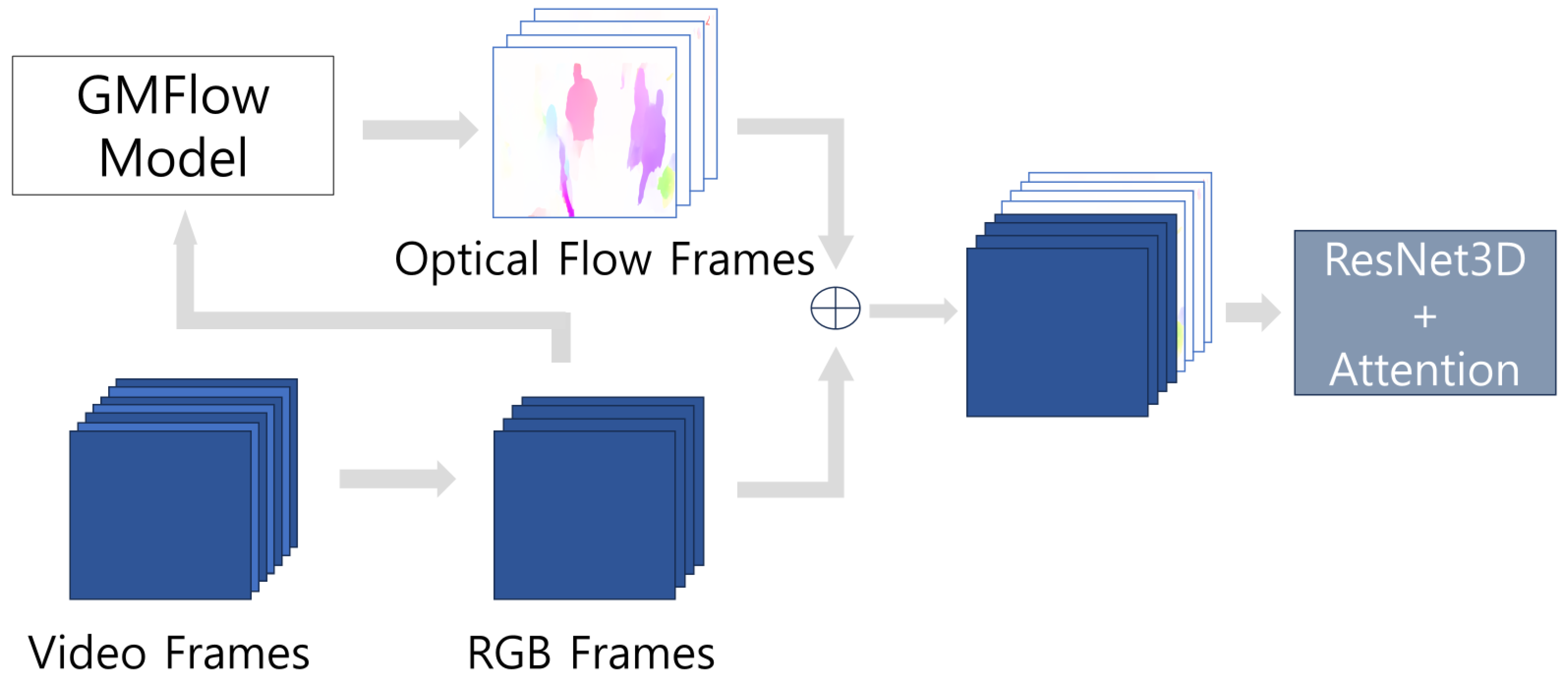
Conv3D-Based Video Violence Detection Network Using Optical Flow and RGB Data

Research Abstract

Detecting violent behavior in videos to ensure public safety and security poses a significant challenge. Precisely identifying and categorizing instances of violence in real-life closed-circuit television, which vary across specifications and locations, requires comprehensive understanding and processing of the sequential information embedded in these videos. This study aims to introduce a model that adeptly grasps the spatiotemporal context of videos within diverse settings and specifications of violent scenarios. We propose a method to accurately capture spatiotemporal features linked to violent behaviors using optical flow and RGB data. The approach leverages a Conv3D-based ResNet-3D model as the foundational network, capable of handling high-dimensional video data. The efficiency and accuracy of violence detection are enhanced by integrating an attention mechanism, which assigns greater weight to the most crucial frames within the RGB and optical-flow sequences during instances of violence. Our model was evaluated on the UBI-Fight, Hockey, Crowd, and Movie-Fights datasets; the proposed method outperformed existing state-of-the-art techniques, achieving area under the curve scores of 95.4, 98.1, 94.5, and 100.0 on the respective datasets. Moreover, this research not only has the potential to be applied in real-time surveillance systems but also promises to contribute to a broader spectrum of research in video analysis and understanding.
Research Authors
Jae-Hyuk Park,Mohamed Mahmoud, andHyun-Soo Kang
Research Date
Research Department
Research Image
Video Violence Detection Network Using Optical Flow and RGB Data
Research Journal
Sensors
Research Pages
15
Research Publisher
MDPI
Research Vol
24
Research Website
https://doi.org/10.3390/s24020317
Research Year
2024

A Comprehensive Survey of Masked Faces: Recognition, Detection, and Unmasking

Research Abstract

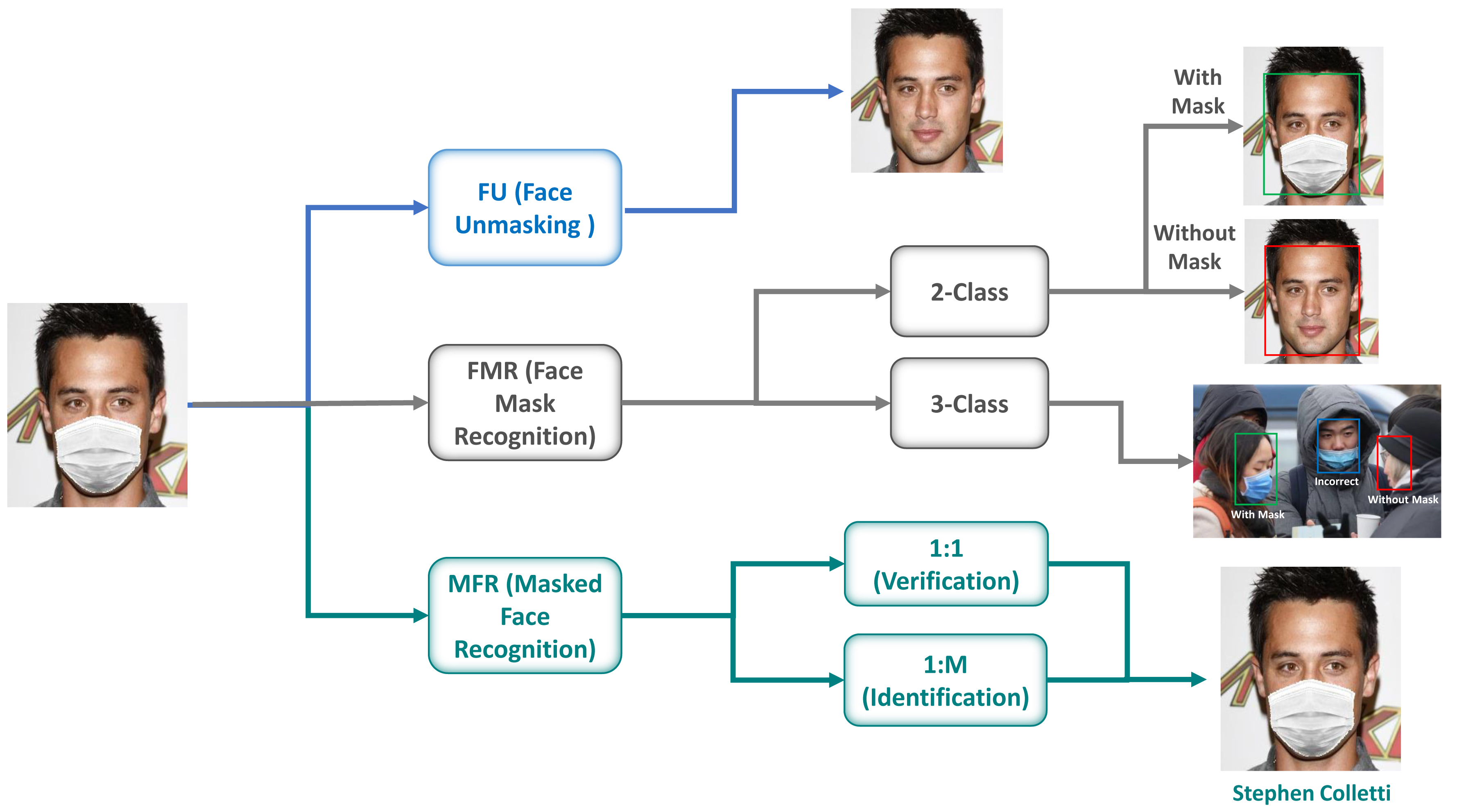
Masked face recognition (MFR) has emerged as a critical domain in biometric identification, especially with the global COVID-19 pandemic, which introduced widespread face masks. This survey paper presents a comprehensive analysis of the challenges and advancements in recognizing and detecting individuals with masked faces, which has seen innovative shifts due to the necessity of adapting to new societal norms. Advanced through deep learning techniques, MFR, along with face mask recognition (FMR) and face unmasking (FU), represents significant areas of focus. These methods address unique challenges posed by obscured facial features, from fully to partially covered faces. Our comprehensive review explores the various deep learning-based methodologies developed for MFR, FMR, and FU, highlighting their distinctive challenges and the solutions proposed to overcome them. Additionally, we explore benchmark datasets and evaluation metrics specifically tailored for assessing performance in MFR research. The survey also discusses the substantial obstacles still facing researchers in this field and proposes future directions for the ongoing development of more robust and effective masked face recognition systems. This paper serves as an invaluable resource for researchers and practitioners, offering insights into the evolving landscape of face recognition technologies in the face of global health crises and beyond.

Research Authors
Mohamed Mahmoud, Mahmoud SalahEldin Kasem, Hyun-Soo Kang
Research Date
Research Department
Research Image
Masked Faces Recognition, Detection, and Unmasking
Research Journal
Applied Sciences
Research Pages
37
Research Publisher
MDPI
Research Vol
14
Research Website
https://doi.org/10.3390/app14198781
Research Year
2024

Statistical-based detection of pilot contamination attack for NOMA in 5G networks

Research Authors
Dalia Nashat, Sahar Khairy
Research Date
Research Department
Research Journal
Scientific Reports
Research Pages
3726
Research Publisher
Nature Publishing Group UK
Research Year
2025

Invitation to hold a validation seminar for the master's thesis of researcher Duaa Ahmed Khilaf in the Department of Computer Science

The Department of Computer Science announces the holding of a validation seminar for the master's thesis of researcher Duaa Ahmed Khilaf, Department of Computer Science. This seminar will be held on Tuesday, July 1, 2025, at 12:00 PM in the Professor Dr. Youssef Bassiouni Mahdi Hall, Department of Computer Science.

news category
Postgraduates
Subscribe to