The Dean of the Faculty announces a change in the composition of the Workshops Unit Board at the Faculty of Engineering.

The Dean of the Faculty of Engineering Announces a Restructuring of the Workshops Unit’s Board of Directors.

Professor Khaled Salah, Dean of the Faculty of Engineering, has announced the issuance of a decree by Professor Ahmed Abdel-Mawla, President of Assiut University—Decree No. (4704) dated October 6, 2026—which restructures the Board of Directors of the Workshops Unit at the Faculty of Engineering for a two-year term.

This decision is made in accordance with the unit’s financial and administrative regulations, and in light of the Universities Organization Law No. (49) of 1972, its executive regulations, and subsequent amendments. The decree is based on the University Council’s approval of the unit’s financial regulations—following their review and endorsement by the Ministry of Finance—as well as the University Council’s successive resolutions to amend Article (3), which governs the composition of the Board of Directors. Furthermore, it follows the University Council’s approval (Resolution No. 774, dated February 24, 2026) to amend Article (3) of the regulations, a change that has also received the approval of the Ministry of Finance.

In its new composition, the Board is chaired by the Dean of the Faculty, with the Head of the Mechanical Design and Production Engineering Department serving as Vice-Chair. The Board also includes the following members:

- The Vice Dean for Community Service and Environmental Development.

- The Head of the Architecture Department.

- The Head of the Electrical Engineering Department.

- Professor Shimi Mohamed Ahmed, Emeritus Professor in the Department of Mechanical Design and Production Engineering.

- Dr. Ahmed Abdel-Alim Amin, Lecturer in the Department of Mechanical Design and Production Engineering.

- Dr. Mahmoud Mohamed Atef, General Supervisor of the Workshops Unit.

- The Secretary of the Faculty of Engineering. - Engineer Mohamed Abdel Moneim Mahmoud Ibrahim, Head of the Engineering Sector at the Asyut Fertilizer Plants.

- Mr. Mohamed Mousa Mohamed, Administrative Manager of the Workshops.

The decision aims to enhance the efficiency of the workshops unit and strengthen its role in supporting educational, research, and community-oriented activities within the faculty, the university, and society at large.

In this regard, Professor Khaled Salah, Dean of the Faculty, extends his congratulations to the members of the council in its newly appointed composition. He also expresses his gratitude and appreciation to the university administration—led by Professor Ahmed Abdel Mawla, President of the University—for issuing this decision.

1
1
1
1
1

Congratulations from the Dean of the College

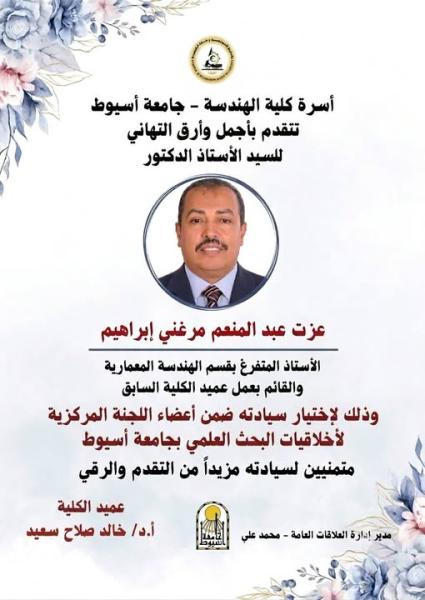
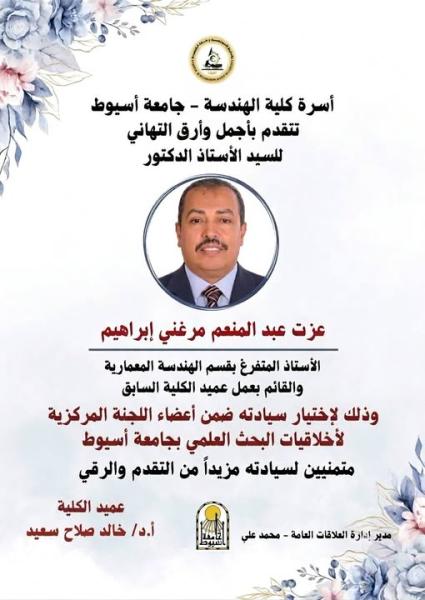
On behalf of the Faculty administration and all its staff and members, Professor Dr. Khaled Salah, Dean of the Faculty, extends his sincere congratulations to Professor Dr. Ezzat Abdel Moneim Marghani—a professor emeritus in the Department of Architecture, former acting Dean of the Faculty, former acting Dean of the Faculty of Fine Arts, and former Vice Dean for Education and Student Affairs—on his appointment as a member of the Central Committee for Scientific Research Ethics at Assiut University. We wish him every success in his new role.

1

Press coverage of the educational programs offered by the Faculty of Engineering at Assiut University

Press Coverage: Educational Programs at the Faculty of Engineering, Assiut University
14 Academic Programs Open Doors to the Future for Assiut Engineering Students: Modern Specializations Aligned with the Labor Market, Including a Medical-Engineering Program in Collaboration with the University of Louisville (USA)

Assiut | Moataz Rifaat

In an era where engineering is no longer limited to lines drawn on paper or machinery operating in factories—but has instead become a language of the future and a tool for shaping life itself—the Faculty of Engineering at Assiut University continues to advance its educational framework. Under the leadership of the Dean, Professor Khaled Salah, the Faculty offers 14 active academic programs. These combine core engineering disciplines with specialized, modern programs designed to keep pace with scientific and technological progress, as well as the demands of the labor market.

The Faculty’s offerings include 10 programs affiliated with its general academic departments, alongside 4 specialized, fee-based programs operating on a credit-hour system. This provides students with a broad range of options to select a specialization that aligns with their personal interests and ambitions, effectively preparing them to enter the rapidly evolving fields of engineering, industry, and technology.

This diversity of programs reflects the commitment of the Faculty of Engineering at Assiut University—under the leadership of Professor Khaled Salah—to enhancing engineering education. By expanding into specialized programs that address labor market needs, the Faculty provides students with both theoretical and practical learning opportunities across a wide array of modern engineering disciplines. First: General Academic Department Programs

1- Civil Engineering Program

This program focuses on preparing engineers capable of utilizing modern technical tools, analyzing engineering problems, and creatively developing solutions. It also qualifies them to work on construction and infrastructure projects.

Graduates acquire skills in design, site supervision and management, selection of construction materials, and the use of advanced engineering software. This opens up diverse career opportunities in design, project execution, supervision, feasibility studies, as well as in surveying, soil testing, and construction materials laboratories.

2- Electrical Power and Machines Engineering Program

This program prepares graduates to design and develop power systems, electric motors, and power electronics. It also covers the application of control and measurement systems, as well as troubleshooting power system faults.

Career opportunities span sectors such as electricity generation, transmission, and distribution companies; conventional and renewable power plants; industrial manufacturing facilities; and firms specializing in automation and industrial control.

3- Electronics and Communications Engineering Program

This program keeps pace with the rapid revolution in the fields of electronics and communications by training engineers specialized in electronic circuits, telecommunication networks, signal processing, and the development of modern communication devices.

Graduates are qualified to work in areas including telecommunication networks, fiber optics, mobile communications, the design and testing of electronic circuits, embedded systems, and radar systems. 4- Computer and Systems Engineering Program

This program offers specialized study in digital systems, embedded systems, hardware programming, control, and artificial intelligence. It prepares graduates to design, implement, and evaluate computer-based systems, qualifying them for careers in digital systems, firmware, the Internet of Things (IoT), and automated control.

5- Architectural Engineering Program

This program integrates architectural knowledge with practical application, equipping students with creative design tools and 3D solutions, while utilizing modern digital technologies such as BIM (Building Information Modeling) and GIS (Geographic Information Systems).

Graduates are prepared for roles in architectural and interior design, urban design, urban planning, building information modeling, engineering consultancy, and project management.

6- Mechanical Power Engineering Program

This program trains engineers specialized in energy science, power generation, HVAC (heating, ventilation, and air conditioning) systems, and mechanical services. Students learn to design, operate, and maintain systems and equipment in accordance with established technical specifications and standards.

Career opportunities span sectors including HVAC and refrigeration, fire protection, oil and energy, power plants, water desalination, and industrial manufacturing.

7- Mechanical Design and Production Engineering Program

This program focuses on the design of machinery and mechanical components, manufacturing processes, production technology, project management, and maintenance, leveraging modern engineering software.

It prepares graduates for professional roles in mechanical design, production, manufacturing, quality control, maintenance, and CAD/CAM applications across various industrial sectors. 8- Mechatronics Engineering Program

This program lies at the heart of interdisciplinary engineering, combining mechanics, electrical engineering, electronics, and computer science to prepare engineers capable of working with intelligent and automated systems.

Fields of practice include industrial automation, mechatronic systems, robotics, automatic control, industrial programming, and the automotive industry.

9- Mining and Mineral Resources Engineering Program

This program focuses on qualifying engineers to utilize modern technologies for prospecting raw materials and construction resources, as well as conducting field surveys and exploration, all with the aim of ensuring the optimal use of mineral wealth.

Graduates may work in sectors such as petroleum, water-well drilling, surveying, mining tunnels, cement manufacturing, and the operation of mines and quarries.

10- Materials and Metallurgical Engineering Program

This program aims to train engineers specialized in the properties of materials and metals, their extraction and heat-treatment processes, quality control, and the execution of physical and mechanical testing.

Graduates are qualified for roles in metal and metallurgical manufacturing, quality engineering, materials testing, smelting operations, and heat treatment.

II: Specialized Fee-Based Programs (Credit-Hour System)

11- Mechatronics and Robotics Engineering Program

An interdisciplinary program that integrates precision machinery, electronics, automatic control, and programming to prepare engineers capable of designing and controlling intelligent equipment and machinery.

Graduates work in fields such as robotics, control systems, and design.

Opening of the academic year and welcoming new students to the college.

Commencement of the Academic Year and Welcoming New Students to the Faculty.

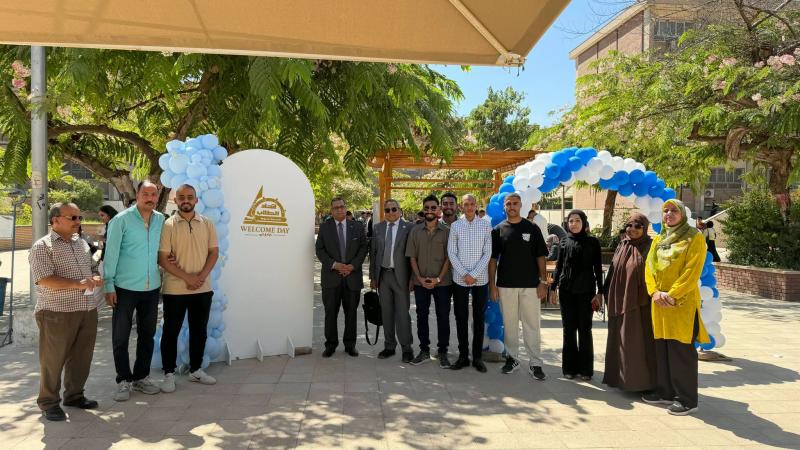
Under the patronage of University President Prof. Ahmed Abdel-Mawla, Faculty Dean Prof. Khaled Salah, and Vice Dean for Education and Student Affairs Prof. Mohamed Safwat Abu-Reya—and under the supervision of the Faculty’s Student Welfare Department—the Faculty Student Union and student activity groups organized a welcome event for new students to mark the beginning of the 2026–2027 academic year. During the event, Dean Prof. Khaled Salah, accompanied by Vice Dean Prof. Mohamed Safwat Abu-Reya, toured the activities prepared for the new students. The Dean commended the student organizers for their efforts in welcoming their new peers, wishing the latter success in their studies. He emphasized that the doors of the faculty leadership remain open to them, ensuring that any obstacles they may encounter during their academic journey can be addressed and overcome.

The Dean also extended his gratitude and appreciation to the Faculty’s Student Welfare Department—represented by Mr. Mohamed Sharaqa and his colleagues—for their dedicated efforts in organizing the welcome event and for their ongoing commitment to supporting both new and returning students.

Under the patronage of University President Prof. Ahmed Abdel-Mawla, Faculty Dean Prof. Khaled Salah, and Vice Dean for Education and Student Affairs Prof. Mohamed Safwat Abu-Reya—and under the supervision of the Faculty’s Student Welfare Department—the Faculty Student Union and student activity groups organized a welcome event for new students to mark the beginning of the 2026–2027 academic year. Professor Khaled Salah, Dean of the Faculty, accompanied by Professor Mohamed Safwat Aboureya, Vice Dean for Education and Student Affairs, inspected the activities organized to welcome new students. He commended the current students for their efforts in supporting their new peers, wishing them success in their academic journey. He further emphasized that the doors of the faculty’s leadership remain open to them, should they encounter any obstacles during their studies.

The Dean also extended his gratitude and appreciation to the Faculty’s Student Welfare Department—represented by Mr. Mohamed Sharaqa and his colleagues—for their dedicated efforts in organizing the welcome event and for their ongoing commitment to the needs of both new and returning students.


Congratulations from the Dean of the College on the start of the new academic year.


Professor Dr. Khaled Salah, Dean of the College, extends his sincere congratulations to the college administration and departments and to all the college’s members, including faculty members, the supporting staff, students, and the college’s administrative staff, on the occasion of the start of the new academic year. Happy new year


Congratulations from the Dean of the College

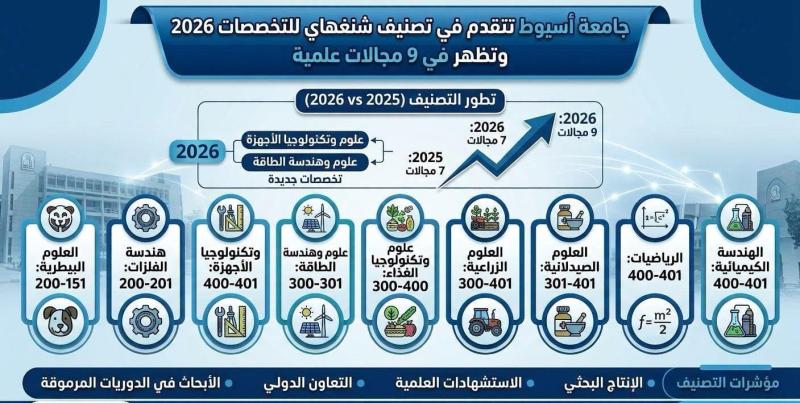
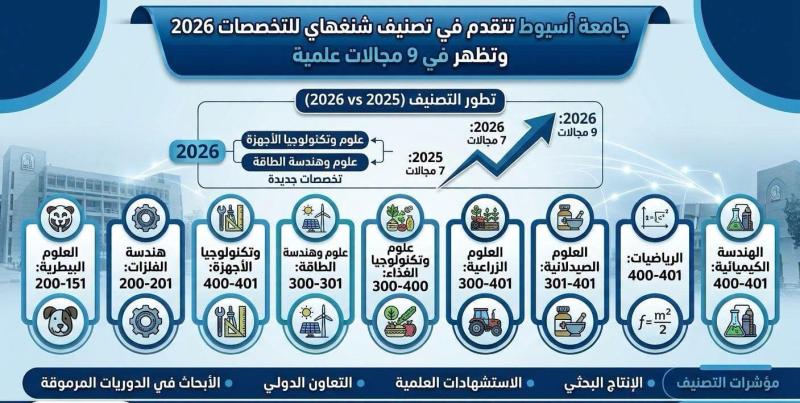
Prof. Dr. Khaled Salah, Dean of the Faculty, extends his sincere congratulations to the university and faculty administrations, as well as to all staff and members, on the outstanding performance in the 2026 Shanghai Ranking of Academic Subjects. Assiut University had previously announced—based on data from the 2026 Shanghai Ranking—that several of its academic disciplines were included in the global rankings, achieving high positions across nine fields, four of which are in engineering.

Prof. Dr. Ahmed Attia, the Faculty’s representative at the University’s International Academic Ranking Office, explained that the engineering-related disciplines appeared in four specialized categories, with rankings as follows:

Metallurgical Engineering: Ranked 201–300 globally.

Instruments Science & Technology: Ranked 301–400 globally.

Energy Science & Engineering: Ranked 301–400 globally.

Chemical Engineering: Ranked 401–500 globally.

The Dean emphasized that these results highlight the significant standing of the engineering disciplines. Engineering disciplines account for four of the nine fields in which the university appeared in the 2026 rankings. This highlights the engineering sector's contribution to the university's international academic and research standing, as well as the distinction of these disciplines—both relative to other universities and within the university and faculty itself. He expressed his gratitude and appreciation to the university administration—led by University President Prof. Dr. Ahmed Abdel-Mawla; Prof. Dr. Gamal Badr, Vice President for Postgraduate Studies and Research and Supervisor of the International Academic Ranking Office; Prof. Dr. Omar Shaaban, Director of the International Academic Ranking Office; and Dr. Ahmed Attia, the faculty’s representative at the office—for their boundless support and significant efforts in showcasing engineering and other disciplines. He also extended his congratulations to the faculty members and supporting staff in the Mining and Metallurgical Engineering, Electrical Engineering, and Mechanical Power Engineering departments, whose research and academic contributions made this achievement possible.

1

Assiut University advances in the 2026 Shanghai Ranking of Academic Subjects, appearing in nine scientific fields.

Prof. Dr. Khaled Salah, Dean of the Faculty, extends his sincere congratulations to the university and faculty administrations, as well as to all staff and members, on the outstanding performance in the 2026 Shanghai Ranking of Academic Subjects. Assiut University had previously announced—based on data from the 2026 Shanghai Ranking—that several of its academic disciplines were included in the global rankings, achieving high positions across nine fields, four of which are in engineering.

Prof. Dr. Ahmed Attia, the Faculty’s representative at the University’s International Academic Ranking Office, explained that the engineering-related disciplines appeared in four specialized categories, with rankings as follows:

Metallurgical Engineering: Ranked 201–300 globally.

Instruments Science & Technology: Ranked 301–400 globally.

Energy Science & Engineering: Ranked 301–400 globally.

Chemical Engineering: Ranked 401–500 globally.

The Dean emphasized that these results highlight the significant standing of the engineering disciplines. Engineering disciplines account for four of the nine fields in which the university appeared in the 2026 rankings. This highlights the engineering sector's contribution to the university's international academic and research standing, as well as the distinction of these disciplines—both relative to other universities and within the university and faculty itself. He expressed his gratitude and appreciation to the university administration—led by University President Prof. Dr. Ahmed Abdel-Mawla; Prof. Dr. Gamal Badr, Vice President for Postgraduate Studies and Research and Supervisor of the International Academic Ranking Office; Prof. Dr. Omar Shaaban, Director of the International Academic Ranking Office; and Dr. Ahmed Attia, the faculty’s representative at the office—for their boundless support and significant efforts in showcasing engineering and other disciplines. He also congratulated the faculty members and supporting staff in the Mining and Metallurgical Engineering, Electrical Engineering, and Mechanical Power Engineering departments, whose research and academic contributions made this achievement possible. Assiut University had previously announced—based on the 2026 Shanghai Ranking of Academic Subjects—that several of its disciplines were included in the global rankings, achieving advanced positions across nine academic fields, four of which are in engineering.

Mr. Eng. ... explained... Dr. Ahmed Attia, the College’s representative at the University’s International Academic Ranking Office, stated that engineering-related disciplines appeared across four specialized categories, with rankings as follows:

Metallurgical Engineering: Ranked 201–300 globally.

Instruments Science & Technology: Ranked 301–400 globally.

Energy Science & Engineering: Ranked 301–400 globally.

Chemical Engineering: Ranked 401–500 globally.

The Dean of the College emphasized that these results reflect the notable standing of the engineering disciplines. Engineering disciplines account for four of the nine fields in which the university appeared in the 2026 rankings. This highlights the engineering sector's contribution to the university's international academic and research standing, as well as the distinction of these disciplines—both relative to other universities and within the university and faculty itself. He expressed his gratitude and appreciation to the university administration—led by University President Prof. Dr. Ahmed Abdel-Mawla; Prof. Dr. Gamal Badr, Vice President for Postgraduate Studies and Research and Supervisor of the International Academic Ranking Office; Prof. Dr. Omar Shaaban, Director of the International Academic Ranking Office; and Dr. Ahmed Attia, the faculty’s representative at the office—for their boundless support and significant efforts in showcasing engineering and other disciplines. He also extended his congratulations to the faculty members and supporting staff in the Mining and Metallurgical Engineering, Electrical Engineering, and Mechanical Power Engineering departments, whose research and academic contributions made this achievement possible.

111

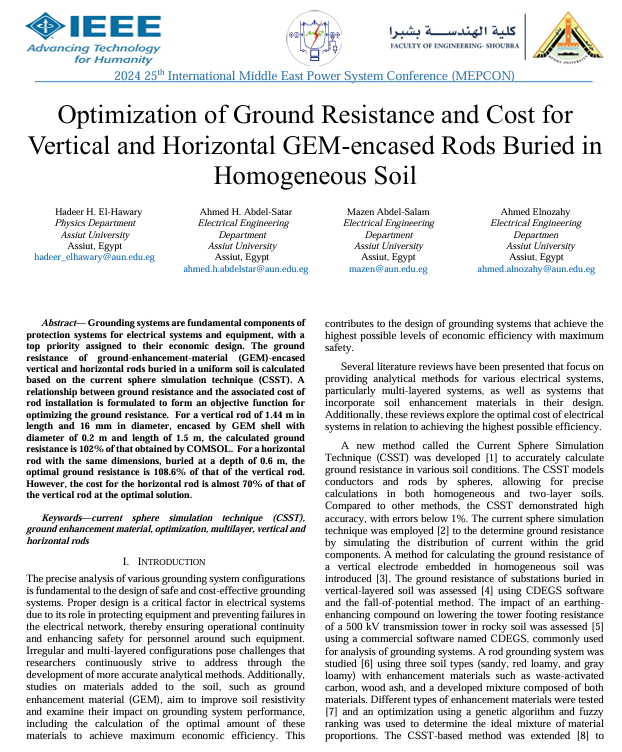
Optimization of Ground Resistance and Cost for Vertical and Horizontal GEM-encased Rods Buried in Homogeneous Soil

Research Abstract

Grounding systems are fundamental components of protection systems for electrical systems and equipment, with a top priority assigned to their economic design. The ground resistance of ground-enhancement-material (GEM)-encased vertical and horizontal rods buried in a uniform soil is calculated based on the current sphere simulation technique (CSST). A relationship between ground resistance and the associated cost of rod installation is formulated to form an objective function for optimizing the ground resistance. For a vertical rod of 1.44 m in length and 16 mm in diameter, encased by GEM shell with diameter of 0.2 m and length of 1.5 m, the calculated ground resistance is 102% of that obtained by COMSOL. For a horizontal rod with the same dimensions, buried at a depth of 0.6 m, the optimal ground resistance is 108.6% of that of the vertical rod. However, the cost for the horizontal rod is almost 70% of that of the vertical rod at the optimal solution.

Research Authors
Hadeer H. El-Hawary, Ahmed H. Abdel-Satar, Mazen Abdel-Salam, Ahmed Elnozahy
Research Date
Research Department
Research Image
Research Journal
International Middle East Power System Conference (MEPCON)
Research Pages
5
Research Publisher
2024 25th International Middle East Power System Conference (MEPCON)
Research Rank
Conference
Research Vol
-
Research Website
https://ieeexplore.ieee.org/document/10850233
Research Year
2024
Subscribe to